
Claude Alexis Gras
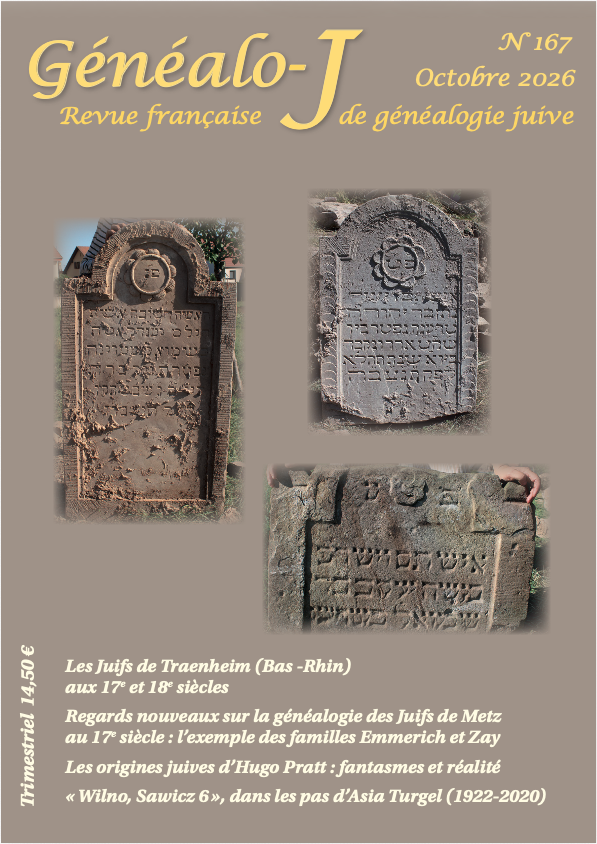
The Jews of Traenheim (Bas-Rhin) in the Seventeenth and Eighteenth Centuries
Recorded in Traenheim (Bas-Rhin) from 1670 onwards, a modest merchant named Costel appears to have been the ancestor of all the Jewish families who lived in the village until the end of the Ancien Régime. Drawing on a wide range of sources—including notarial deeds, tax registers, epitaphs, and circumcision records—this study seeks to reconstruct as accurately as possible the genealogy and history of these families. It focuses first on the descendants of Costel, but also on the Lang and Schwartz families, the latter including descendants of distinguished rabbis, statesmen, and mathematicians.
Jean‑Claude Bouvat‑Martin et Pierre‑André Meyer
New Perspectives on the Genealogy of the Jews of Metz in the Seventeenth Century. The Example of the Emmerich and Zay Families
Seventeen years after the publication of The Jewish Community of Metz and Its Families (1565–1700) by the late Pascal Faustini, the authors have published a new work on the same subject, including substantial additions and revisions. Based primarily on newly discovered notarial documents, together with a re‑examination of entries in the Memorbuch of the Jewish community of Metz, it answers several genealogical questions left unresolved by Faustini and corrects a number of genealogical errors in his work. This article, devoted to one of the community’s leading families, provides an illustration. Starting from the discovery of a Hebrew deed of sale dated 1663, the authors present a genealogy of the branch of Gerson Emmerich and Mordechai known as ‘of Holland’, which differs significantly from the genealogy presented by Faustini in the Emmerich chapter of his work and also revises his conclusions concerning the Zay family.
Denis Lévy
The Jewish Origins of Hugo Pratt. Myth and Reality
Hugo Pratt, the great Italian comic‑book author, claimed Jewish ancestry on his mother’s side. Pratt had an exceptional gift for storytelling, as demonstrated by his famous character Corto Maltese. But what about his own family? This article seeks to distinguish fact from fiction behind these claims.
Muriel Chochois
"Wilno, Sawicz 6", in the Footsteps of Asia Turgel (1922–2020)
“Sawicz 6,” a gateway leading to a courtyard surrounded by buildings comprising about thirty dwellings, with a shop opening onto the street to the left of the entrance and a door giving access to the courtyard… This present‑day Vilnius landscape is the same one Asia Turgel knew during the eighteen years she lived there with her family, from 1922 to 1941. The physical setting has remained largely unchanged, while the memory of those who lived there—until the days between July and September 1941 when they were murdered or taken to the ghetto—is gradually fading. Asia’s testimony, based on census records of the courtyard’s predominantly Jewish residents, brings several names and life stories back to light. Building on this testimony through further genealogical research, this article retraces, in Asia Turgel’s footsteps, the lives and destinies of the men, women and children who lived in this place.